
Hill County Traffic Warrants Explained
A traffic warrant usually follows a case-specific event, such as missing the appearance date printed on a citation or not satisfying a judgment. The citation identifies the court and deadline; it does not establish that a warrant issued. Hill County’s reviewed sources do not give a uniform number of days from default to process, so call the issuing clerk to learn the docket’s current status.
City citations can belong to Hillsboro, Whitney, Itasca, or Hubbard municipal court. A county-road ticket may instead go to the JP precinct named on it. The court decides whether payment, an appearance, a motion, or bond is needed. A payment portal is not proof that a separate warrant has been recalled.
Hill County Traffic Routes Start With the Citation
The four JP courts serve different precincts: JP 1 is in Whitney, JP 2 in Hillsboro, JP 3 in Malone, and JP 4 in Itasca. Do not pick an office by residence alone. Read the court name on the ticket, then confirm the precinct and case number before sending a payment or filing. The County Justice page provides the current precinct contacts.
For a city-issued ticket, use the municipal court named on the citation. Hillsboro publishes citation forms and an online payment route; Whitney links traffic-ticket payment; Itasca publishes detailed appearance and plea instructions; Hubbard’s court landing page has fewer operational details. None of these reviewed pages provides a public warrant roster.
Use the official Hill County Justice of the Peace directory to identify the JP that matches the citation.
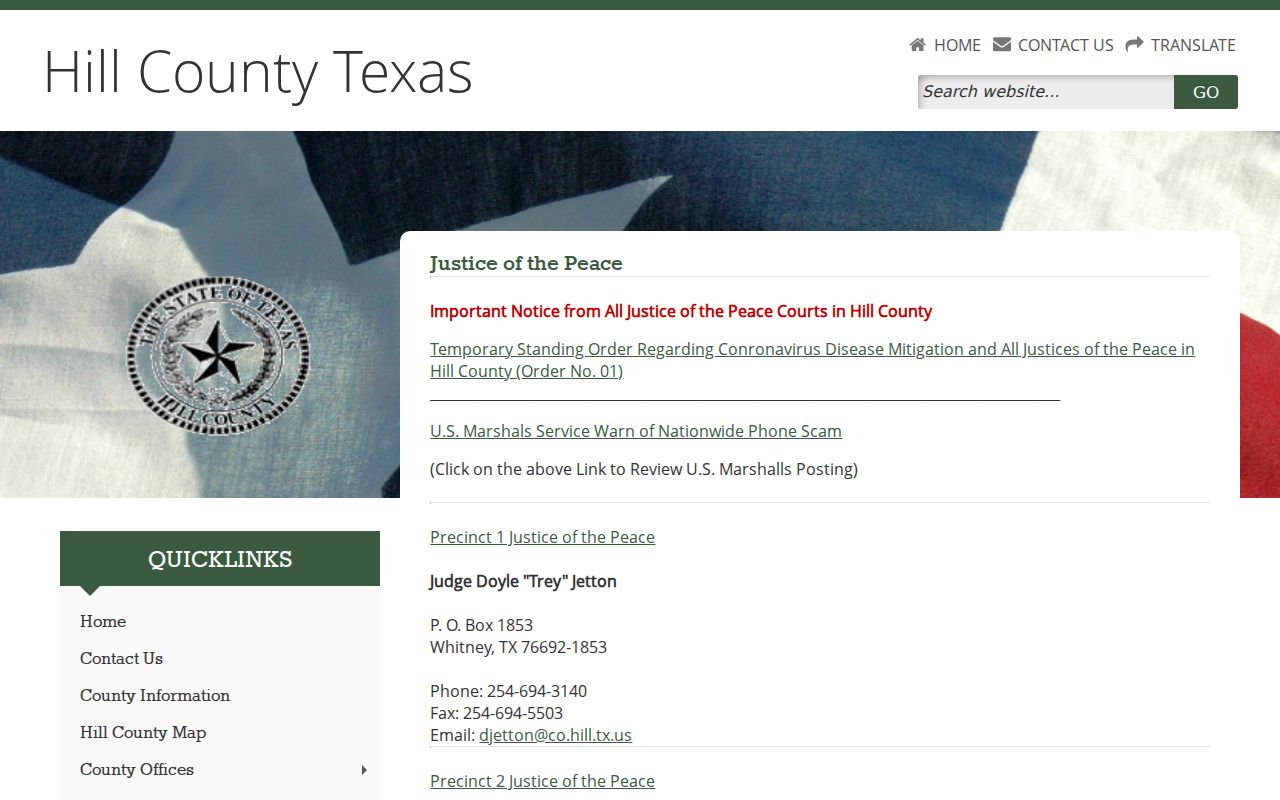
The directory is a routing reference, not a case-status search. After using it, call the court with the citation number and ask about any active capias or required hearing.
Checking for a Traffic Warrant
Start with the issuing court instead of a statewide license portal. Have the citation or cause number, the name on the case, the offense date, and any notice or court date available. Ask whether the case is still payable, requires a setting, or has a warrant or capias. If no online result appears, that is not a clearance; ask the clerk directly.
- Read the ticket and identify its municipal court or JP precinct.
- Use that court’s official citation or payment page only for the functions it describes.
- Call the clerk if the notice says FTA, capias, or warrant, or if the online result is unclear.
- Ask counsel about a hearing or other resolution before appearing when arrest risk is a concern.
Hill County License Holds Do Not Confirm Warrants
Texas DPS describes its Failure to Appear/Failure to Pay program as a license-renewal reporting channel. A court may report a matter that affects renewal, but DPS materials say license specialists cannot determine whether a person has an active warrant. Contact the reporting court for the underlying citation, capias status, amount due, and clearance instructions.
If several courts appear in a license notice, handle each separately. The issuing court must report resolution through its process; a person may need to allow the court’s stated processing time before checking the license record again. Keep the payment receipt or filed request and ask the clerk when the status should update.
The Texas Transportation Code Chapter 706 describes the statutory framework behind FTA/FTP reporting. It is not a Hill County warrant database.
Use the statute to understand why a hold may exist, then ask the specific court how it will report a cleared case.
Inside a Traffic Warrant Record
No verified public Hill County traffic-warrant sample or field-level export was located. The fields below are a checklist for a conversation with the court, not a promise that an online result displays them. Confirm the court and citation first, then ask whether the case is at a payment, missed-setting, warrant, or post-judgment stage.
| Warrant / Citation Number | Use the number on the ticket or court notice; no countywide format was verified. |
|---|---|
| Charge / Offense | Ask the clerk to confirm the filed charge and offense date. |
| Issuing Court | Identify the city court or JP precinct named on the citation. |
| Balance / Bond | Request the current court amount and whether payment alone is accepted. |
| Status | Ask whether the case is open, in warrant process, recalled, or reported cleared. |
Itasca and Hillsboro Publish Different Procedures
Itasca’s municipal procedure page gives a clear example of why local rules matter: it ties appearance to the citation, summons, or release date; describes pleas and monthly pretrial; and states a $50 fee if a warrant is served or processed. It also says a $15 time-payment fee may apply after 31 days. Those amounts belong to Itasca’s stated process, not every Hill County court.
Hillsboro posts forms for pleas, extensions, dismissal requests, appeal bonds, and driving safety courses. Its course form requires court permission and supporting details, so sending the form does not itself recall a warrant. Whitney and Hubbard have different public details. Ask the relevant clerk what applies to the individual docket.
The Itasca court’s published procedures should be checked with the clerk before relying on a fee or deadline.
How to Pay or Lift a Traffic Warrant
Do not assume that a ticket payment and a warrant recall are the same step. Before paying, ask the court whether the case is eligible for payment, whether a hearing or motion is required, what total is currently due, and how the court will confirm that process has been recalled. When the case is contested, ask about the proper appearance or bond route rather than guessing from a payment page.
- Confirm the issuing court, case number, process status, and full amount.
- Ask whether to pay, request a setting, file a motion, or arrange a bond.
- Use only the accepted filing or payment route given by that court.
- Get written confirmation of recall and ask separately about any DPS clearance report.
Warning: A payment receipt may not establish that a warrant was recalled; confirm the court’s docket and address any separate license hold with its reporting court.
Keep a Hill County Traffic Resolution Record
Save the citation, court contact, filed form, payment receipt, bond receipt if applicable, and any written recall or clearance confirmation. Record the date the clerk expects the docket or DPS status to change. These documents help distinguish an unpaid balance from an open capias and from a license report that has not yet cleared.
The reviewed county and city sources do not announce a Hill County traffic warrant roundup or a special countywide amnesty. If a court mentions a temporary program, ask for the dated official notice and its eligibility rules. Do not rely on an old announcement or a general “warrant weekend” post to determine what the present case requires.
Traffic Warrants, FTA, and License Holds
One missed traffic matter can produce different consequences, but the terms are not interchangeable. A court warrant or capias concerns court process. An FTA/FTP report can affect license renewal through DPS. The case may involve both, either, or neither; ask the court to identify each status and its own next step.
| Mechanism | What Triggers It | What It Does |
|---|---|---|
| Traffic warrant or capias | Court process tied to the case | Requires the issuing court’s status and resolution instructions |
| FTA / FTP report | Court reports a failure under the state program | May affect driver-license renewal; contact reporting court |
| License hold | Administrative record of a reported matter | Clearance follows the reporting court’s process |
Hill County Citation Records Need a Narrow Request
If a court does not provide an online status search, ask for existing records that identify its current procedure for checking and clearing a traffic FTA or capias. A focused request can seek official payment forms, appearance instructions, fee schedules, or the office that reports clearance to DPS. It need not request every warrant or demand that a clerk create a new list.
For a public-information request to the Sheriff, use the listed open-records contact and follow its estimate and payment instructions. Court case access belongs with the court’s clerk. Keep any response and ask which office can confirm an individual case.
Hill County Capias Pro Fine Has Its Own Court Route
A capias pro fine concerns an unpaid judgment and follows the issuing court’s process. Texas Code of Criminal Procedure Chapter 45A addresses justice and municipal court procedures, but it does not identify an individual’s case status or amount due. Ask the court whether a capias issued and which remedy, appearance, payment plan, or other action it permits.
The Texas Code of Criminal Procedure Chapter 45A is the statutory source for this local court-process context.
The statute is background information; the court named on the citation must confirm the record and available next step.